Somebody said the words “root canal” and your whole body reacted before your brain caught up. That reaction is not your fault. It was built by decades of jokes, sitcom punchlines, and stories from people describing a procedure that has changed a great deal since they had it.
Here is the honest truth, said plainly: for most people, a root canal today feels a lot like getting a filling. The thing that hurts is the infection. The procedure is what stops it.
At SiRa Dentistry in Spotswood, Dr. Peter Mikhail and Dr. Michael Massoud treat patients across Central Jersey who arrive braced for the worst and leave surprised. If you have a tooth that throbs, wakes you up at night, or aches when you bite down, call our office at (732) 454-7472 and let us look at it before it decides for you. You can also read about our services any time.
Let’s take the fear apart piece by piece.
What a Root Canal Actually Is
Inside every tooth there is a soft core called the pulp. It holds the nerve and the blood supply. When decay gets deep enough, or a crack lets bacteria in, or an old filling fails, that pulp becomes infected.
Infected pulp does not heal on its own. It is sealed inside a hard tooth with nowhere to drain, which is exactly why the pain can be so relentless and so specific.
A root canal removes that infected tissue, cleans and disinfects the narrow canals inside the root, and seals them so bacteria cannot return. The tooth stays. The infection goes.
That is the whole idea. It is not the source of the pain. It is the end of it.
Why the Reputation Is Out of Date
The reputation comes from a real place. Decades ago the procedure was slower, the anesthetic was less predictable, and the tools were cruder. People remember it, and they tell their kids about it.
Three things changed.
Anesthesia got better. Numbing an infected tooth used to be genuinely difficult, because inflamed tissue resists anesthetic. Modern technique and modern agents handle it far more reliably.
The tools got smaller and smarter. Rotary instruments and digital imaging mean less guessing, fewer passes, and less time in the chair.
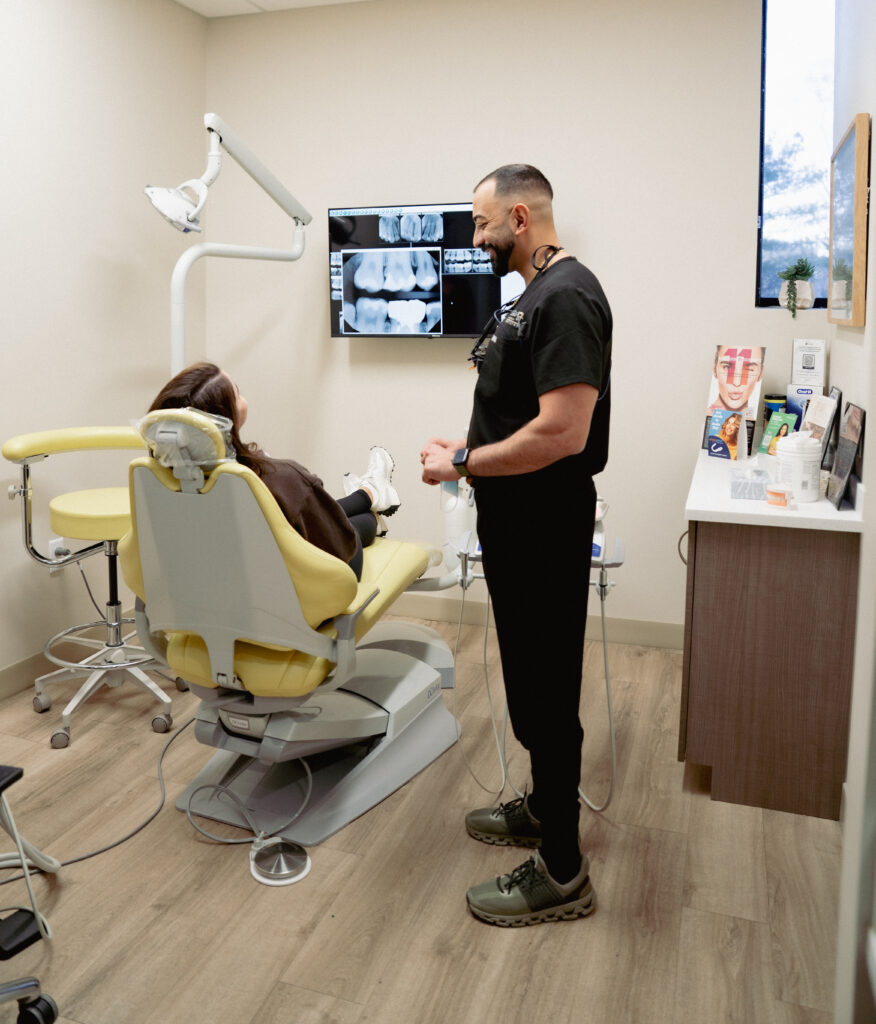
Sedation is on the table. If the appointment itself is the problem rather than the tooth, we offer sedation. You do not have to white-knuckle your way through it, and you do not have to be sent somewhere else to get it.
What the Appointment Is Like
| Step | What happens | What you feel |
|---|---|---|
| 1Diagnosis | X-ray and testing to confirm the pulp is involved | Nothing beyond a normal exam |
| 2Numbing | The tooth and surrounding area are anesthetized | A pinch, then nothing |
| 3Access | A small opening is made in the top of the tooth | Pressure, no pain |
| 4Cleaning | Infected tissue is removed, canals are cleaned and shaped | Vibration, pressure |
| 5Sealing | Canals are filled and sealed against bacteria | Pressure |
| 6Restoration | A filling, and usually a crown, to rebuild strength | Normal restorative work |
Most single-root teeth are done in one visit. Molars have more canals and sometimes take two.
The part patients tell us they did not expect is how ordinary it feels. Long, yes. Boring, often. Traumatic, rarely.
Signs You Might Need One
– A toothache that lingers rather than passing in a moment
– Pain that wakes you at night or worsens when you lie down
– Sharp pain when you bite down on that specific tooth
– Lingering sensitivity to hot or cold after the source is gone
– A pimple-like bump on the gum near the tooth
– A tooth that has darkened compared to its neighbors
– Swelling in the face or jaw, which is urgent
That last one deserves its own sentence. Facial swelling with a bad tooth is not a wait-and-see situation. Call us the same day.
Worth knowing: a tooth can need a root canal without hurting at all. A nerve can die without announcing it, and the infection keeps going after the pain stops. Pain going away is not the same as a problem going away.
The Alternative, and Why We Talk About It Honestly
The other option is extraction. Pulling the tooth ends the infection too, and it is usually cheaper on the day.
What extraction costs you shows up later. The bone that held that root begins to shrink. Neighboring teeth drift. The tooth above or below has nothing to bite against and starts to move. Replacing it well means an implant or a bridge, both of which cost more than the root canal would have.
We place implants here, so we are not steering you toward a root canal to avoid a procedure we do not do. We say this because keeping your own tooth is almost always the better outcome when the tooth is savable.
Sometimes it is not savable. A tooth that is cracked below the gumline or has lost too much structure has a poor prognosis, and we will tell you so rather than sell you a treatment that fails in two years.
What It Costs, and What We Do About the Number
Cost depends on which tooth, how many canals, and whether a crown is needed after. Front teeth are simpler. Molars are more involved.
What matters more than the range is how you find out. You get a written estimate before anything begins, and the estimate is the bill. No add-ons appearing at checkout.
And if the plan changes once we can see inside, we stop. We explain what we found, update the number, and you decide before we go a step further. We call it the Pause Rule and it applies to every procedure in this office.
For patients without insurance, we have an in-house membership plan and zero-percent financing available, because cost should not be the reason a tooth gets pulled that could have been saved.
Frequently Asked Questions
Does a root canal hurt?
The infection hurts. The procedure relieves it. With modern anesthetic, most patients report the appointment feels like a long filling. Soreness for a day or two afterward is normal and manageable with over-the-counter medication.
How long does it take?
Usually 60 to 90 minutes for a single visit. Molars with more canals sometimes need a second appointment.
Do I really need a crown afterward?
Usually yes, on back teeth. A treated tooth is more brittle, and a crown protects it from fracturing under chewing force. Skipping it is the most common reason a root canal fails years later.
Can I just get it pulled instead?
You can, and sometimes that is the right call. But losing a tooth starts a chain of bone loss and shifting that costs more to fix than the root canal would have. We will walk you through both honestly.
Can I be sedated for it?
Yes. If anxiety is the real obstacle, tell us when you call and we will plan the appointment around that.
How do I know if it is an emergency?
Facial swelling, fever, or pain you cannot control at home means call us the same day. We keep room for emergencies.
If a tooth is bothering you and you have been putting off finding out why, call SiRa Dentistry at (732) 454-7472. Knowing is cheaper than waiting, in every sense.
Schedule a consultation at SiRa Dentistry or call (732) 454-7472. Dr. Mikhail and Dr. Massoud proudly serve Spotswood, East Brunswick, Monroe Township, Old Bridge, and communities across Middlesex County.
—
SiRa Dentistry is located at 456 Main St, Spotswood, NJ 08884. Simply Radiant Dentistry — because your smile should be exactly that.